Fixing the RTI Gap: Trading Screener Guesswork for Diagnostic Precision
Universal reading screeners (such as Acadience, DIBELS, iReady Reading, and STAR Reading) are designed to tell you who is struggling, not why or how to help them. They simply can't tell a teacher what to teach tomorrow morning. Telling an educator that a student is reading "below grade level" is like a mechanic saying your car won't start; it flags the problem, but it doesn't tell you what’s actually broken under the hood.
To close our nation’s profound literacy gap, schools need an operational blueprint. At Root Literacy Design, we work virtually with leadership teams across the country to bridge this gap by writing customized, grade-level literacy flowcharts that show teachers exactly when to transition from a broad screener to a deep diagnostic assessment. Let’s unpack the Reading Rope to see how trading screener guesswork for total diagnostic precision completely transforms RTI and student outcomes.
Unpacking the Reading Rope: The Intervention Bottleneck
According to cognitive models like Scarborough’s Reading Rope, reading comprehension is the intertwined product of word recognition and language comprehension. Longitudinal research consistently shows that 70% to 80% of struggling elementary readers face challenges rooted directly in the Word Recognition strand (Moats, 2020).
When a student cannot decode accurately and automatically, their entire cognitive focus is completely consumed by sounding out words. This leaves virtually no working memory available for processing meaning. Because word recognition is the mechanical gateway to literacy, mastering these foundational skills is completely non-negotiable.
The biggest bottleneck in RTI occurs directly between the universal screener and forming interventions. Too often, schools misuse screeners by attempting to turn surface-level data into intervention groups and instructional goals—which is fundamentally outside their intended use.
If a standard screener flags an upper-elementary or secondary student for "Decoding," what do you actually teach them tomorrow morning? Do they struggle with:
Letter-sounds?
Irregular high frequency words?
Short vowels?
Digraphs?
R-controlled vowels?
Affixes?
Without a diagnostic, next steps are just guesswork. You risk wasting valuable intervention minutes either drilling skills they’ve already mastered, or overshooting their instructional level entirely—like asking a student to blend words containing letter-sounds they do not know.
Meanwhile, their true reading gaps go unaddressed. Worse yet, this guessing game is a luxury many older readers never even get; once a student hits third grade and beyond, a low reading score rarely triggers a decoding test at all.
The Solution: Bridging the Gap with Root Compass
This structural bottleneck is exactly why we built Root Compass. It is a foundational literacy diagnostic focused entirely on word recognition. It doesn’t replace your universal screeners—you still need those to flag the risk and track students' reading progress. Instead, it pinpoints exactly why students struggle to read words, transforming your RTI model from a guessing game into a precise science through a seamless, two-step system:
STEP 1: THE FOUNDATIONAL PRE-ASSESSMENT (THE ROADMAP)
This is a rapid, high-level survey for Grades 2–12 designed to instantly catch any student struggling with word recognition. By using a strategic mix of isolated real and nonsense words across three critical layers, we remove a student's ability to guess based on context clues or memory:
Layer 1 (Single-Syllable Nonsense Words): Instantly checks if basic sound-symbol correspondences are genuinely mapped, forcing the student to rely on phonics rather than visual memory.
Layer 2 (Multisyllable Syllabication): Tests if the student can successfully chunk and decode longer words made up by the six core syllable types.
Layer 3 (Multisyllable with Affixes): Pinpoints whether the student can decode complex words containing common prefixes and suffixes.
STEP 2: THE DIAGNOSTICS (THE PLAN)
Deployed when a student flags on the Pre-Assessment (and can be administered to all K–1 students). Instead of guessing, you administer granular sub-tests to isolate the exact breakdown point:
Alphabet Knowledge & Print Identification: Assesses ability to say the alphabet, and identify letters and numbers of various everyday fonts.
Letter-Sounds & Handwriting: Evaluates vital print-to-sound connections and motor-mechanic execution.
Irregular High-Frequency Words: Assesses mastery of common “heart” words to ensure accurate orthographic mapping.
Decoding & Morphology: Measures phonograms across all six syllable types using single and multisyllable variations alongside common affixes.
Understanding the Differences: Screeners vs. Diagnostics
Root Compass does not duplicate the data your screener has gathered. It’s the next step necessary to diagnose the cause of the student’s reading difficulty and provide targeted instruction. Here’s an overview of how screeners and diagnostics work together:
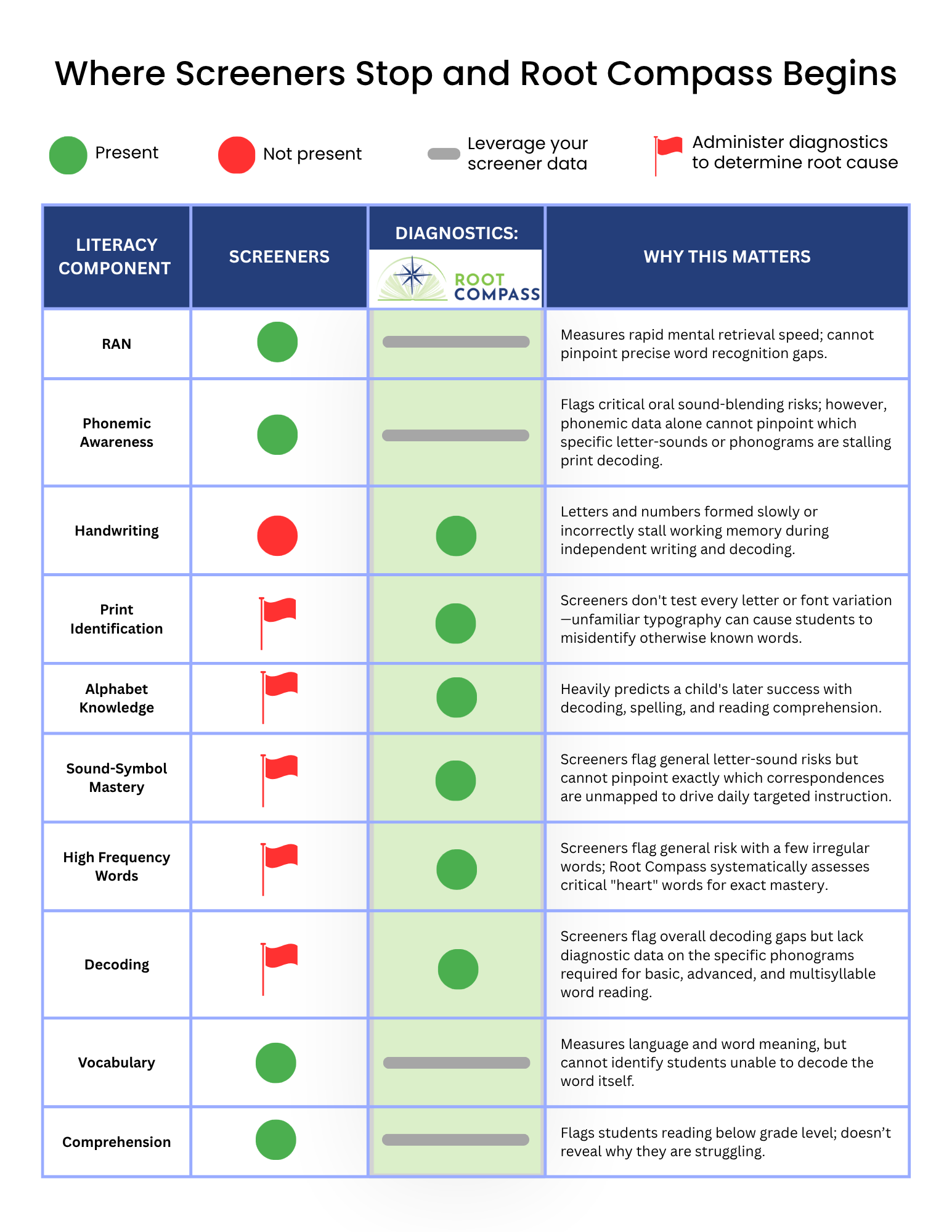
Stop Driving Interventions with Guesswork
When we couple our universal screener with deep foundational diagnostics, the RTI model transforms from an operational guessing game into an empirical science.
Instead of an intervention block where a teacher reviews a broad, generalized phonics lesson to a mixed group of eight struggling readers, you can now group students by hyper-specific skill deficits rather than vague reading levels. You can place three students together who specifically struggle with digraphs, and another two who need explicit work on handwriting.
Stop drowning in disconnected spreadsheets. Stop guessing instructional goals. Target deep diagnostic results into targeted groups and precise instructional plans to reclaim your time and deliver the exact, root-cause instruction your students need.
Transform Your RTI Guesswork into Empirical Science
When you couple your universal screener with deep foundational diagnostics, your RTI model transforms from an operational guessing game into an empirical science. Instead of an intervention block where a teacher reviews a broad, generalized phonics lesson to a mixed group of eight struggling readers, you can now group students by hyper-specific skill deficits.
Transitioning your district to this level of data precision doesn't happen overnight, but continuing to run interventions blindly is no longer an option. Stop drowning in disconnected spreadsheets, and build the system your teachers deserve.
Partner with Root Literacy Design to bring our complete, nationwide virtual custom support to your schools:
The Literacy Audit & Action Plan: We evaluate your current systems and write a definitive roadmap for growth.
Customized Grade-Level Flowcharts: We design clear, visual operational pathways for your staff, with Root Compass seamlessly built-in as the diagnostic engine that guides daily instruction.
The Implementation Ecosystem: Science of Reading training, virtual professional development, and a year-long coaching practicum for both classroom teachers and literacy coaches.
Let’s work together to look at your data, align your workflows, and maximize every single minute of your instructional day. Schedule your complimentary virtual consultation with Root Literacy Design today!

Join the Root Literacy Design Community
We help educators implement evidence-based practices so all students learn to read and write.
Join our newsletter by filling out the simple form at the bottom of any page of our website to be the first to know about offerings, sales, and more. Together we can build a strong foundation for literacy success!
Until all of our students can read and write,
Heather Ballantine, Founder & CEO of Root Literacy Design LLC